From the Intelligent Edge to Modern Archive: Redefining the S3 Experience with Ethernet-Native Long-Term Storage Infrastructure
Enterprises are standardizing on S3 for backup, archive, and data lakes, but keeping everything online is driving up storage costs and risk. The joint solution from ATTO and PoINT Software & Systems connects S3-native workflows to Ethernet-based tape infrastructure, automatically tiering cold data to a cyber-resilient, ultra-low-cost archive layer—without changing how applications talk to S3
Solution Overview
PoINT Archival Gateway exposes a standard S3 interface and intelligent lifecycle engine, while ATTO XstreamCORE bridges SAS tape libraries directly into Ethernet environments. Applications and backup tools continue to write to S3, and the solution transparently moves cold or compliance data to LTO tape, creating air-gapped copies that flatten long-term storage TCO.
Organizations gain a simpler, scalable architecture for long-term retention that aligns security, performance, and budget with modern cloud, analytics, and AI-driven workflows.
Key Benefits
- S3 simplicity with deep archive economics
Keep S3 as the primary interface while policy-driven tiering moves cold objects from costly disk or cloud tiers to high-density tape, cutting long-term OPEX without retraining users or refactoring applications. - Turn cold data from a liability into a strategic asset
Maintain S3-addressable metadata even when payloads live on tape so archive data stays discoverable and retrievable for AI, analytics, and compliance—rather than locked away in a silo. - Cyber-resilient, air-gapped protection
LTO-based copies created via Ethernet-connected tape libraries provide a physically isolated last line of defense against ransomware and backup-targeted attacks. - High-throughput ingest and restores
PoINT Archival Gateway supports massive parallelism and can move more than a petabyte per day, while ATTO XstreamCORE delivers line-rate transport of SCSI tape commands over Ethernet for fast, large-scale restores. - Flexible, future-ready design
Decouple tape from legacy server-bound architectures, eliminate forklift upgrades, and adapt tape capacity and retention policies as requirements grow and regulations change
How It Works
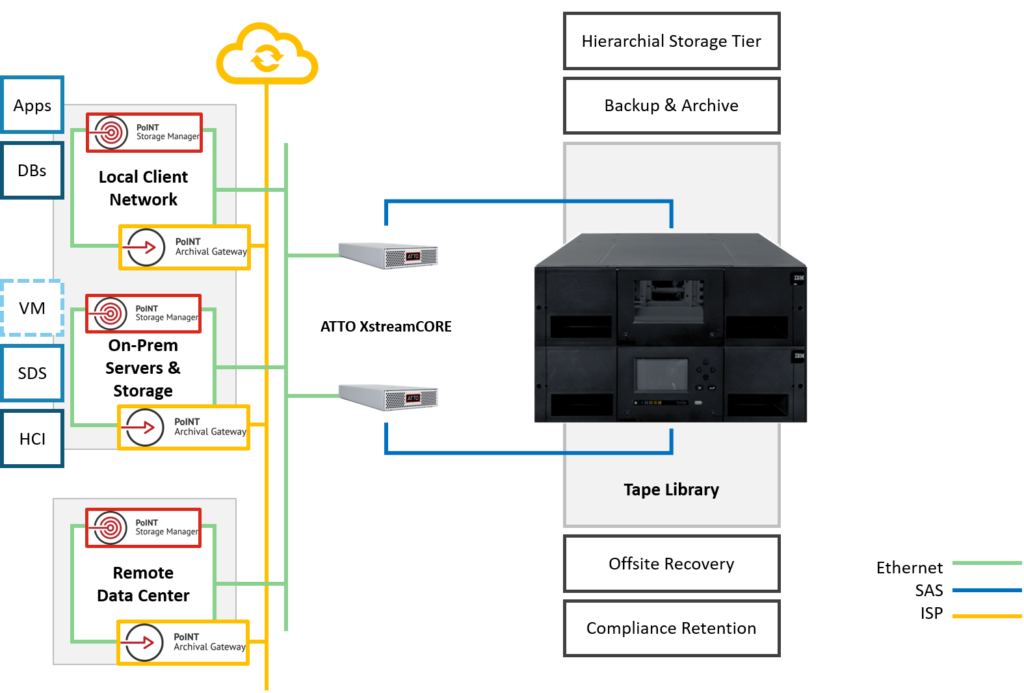
- S3 front end with PoINT Archival Gateway
Applications, backup software, and data management tools read and write using standard S3 APIs against PoINT Archival Gateway, which presents itself as an S3-compatible endpoint or bucket to preserve existing workflows. - Intelligent lifecycle and policy engine
PoINT Archival Gateway decides which objects remain on online storage and which are archived to tape, while preserving metadata so tape-resident data remains addressable via S3 semantics. - Ethernet-to-tape with ATTO XstreamCORE
ATTO XstreamCORE connects SAS-based tape drives and libraries to existing Ethernet networks, allowing multiple hosts to read and write to tape in parallel—even as S3 backups run—without operating system dependencies. - End-to-end S3-to-Tape tiering
Multiple PoINT Archival Gateway nodes connect over Ethernet to ATTO XstreamCORE, creating a scalable S3-to-Tape pipeline that collapses cloud, disk, and tape silos into a single, manageable tiering architecture.
.
Ideal Use Cases
- Long-term retention for compliance-heavy industries that must preserve data for years or decades at predictable cost.
- Ransomware-resilient backup strategies that require physically air-gapped copies as a last line of recovery.
- Petabyte-scale archives and data lakes where the majority of data is cold but must remain accessible via S3 for future analytics and AI workloads.
- Hybrid cloud environments seeking to reduce cloud archive and retrieval fees by offloading cold S3 data to on-prem tape via Ethernet.
ATTO and PoINT: Better Together
PoINT Archival Gateway delivers scalable, standards-based S3-to-tape lifecycle management, while ATTO XstreamCORE provides high-performance Ethernet connectivity to SAS tape infrastructure. Together, they give IT teams a unified, S3-first approach to data management that lowers cost, strengthens cyber resilience, and keeps more data available for longer—without adding complexity or disrupting existing workflows