Software RAID: A New Default for Data Protection?
By Azim Malik, Product Manager, ATTO Technology, Inc.
Hardware RAID was built for an era where compute was scarce, constrained, and offload was essential. Today, the environment it operates in has undergone an intense transformation.
For years, hardware RAID was the standard approach to managing SAS and SATA storage. It offloaded compute, simplified deployment, and delivered predictable performance in environments where CPU resources were limited.
That context has fundamentally shifted and no longer applies.
Here’s why.
The Shift: From Offload to Abundance
Hardware RAID emerged in a time when CPU resources were limited. Tasks like parity calculations, drive rebuilds, and data management placed significant strain on system processors, making offloading these functions to dedicated RAID controllers a practical and efficient approach.
Today, those same operations represent a small fraction of available compute resources – handling RAID workloads with minimal impact on application performance.
Performance: Fixed Pipelines vs Scalable Parallelism
Hardware RAID delivers performance through dedicated silicon, cache, and optimized firmware. In specific scenarios – particularly small-block, write-heavy workloads – features like write-back cache, often battery or flash-backed, can reduce latency and absorb bursts.
But these approaches have limits:
- Performance is bound by controller architecture
- Scaling requires upgrading, adding, or replacing hardware
- Queue handling and processing remains centralized
Software RAID on the other hand takes a different approach:
- Leverages multi-core CPU parallelism
- Uses system memory and OS-level caching
- Scales with overall system capability
In many SAS/SATA deployments, especially those dominated by HDDs or mixed workloads, the performance difference is negligible or can even favor software RAID due to greater parallelism and fewer controller bottlenecks.
Flexibility and Architectural Alignment
Modern infrastructure is increasingly software-defined. Applications are containerized, environments are virtualized, and resources are allocated dynamically.
Hardware RAID logic, by design, is tightly coupled to a physical controller:
- Configuration is tied to specific hardware
- Portability across systems is limited
- Feature evolution depends on controller firmware
Software RAID aligns more naturally with today’s architectures:
- Managed at the OS or platform level
- Easier to automate and integrate into existing frameworks
- Portable across hardware and virtual environments
This flexibility becomes especially valuable in large-scale or rapidly evolving deployments. Instead of a physical chip on the card calculating parity, the system’s CPU and Operating System manage the RAID array.
Cost and Operational Efficiency
Dedicated RAID controllers introduce additional cost and complexity:
- Hardware acquisition and lifecycle management
- Power and cooling overhead
- Vendor-specific dependencies
Software RAID eliminates that layer, enabling:
- Lower bill of materials
- Simplified system design
- Greater investment in higher-impact components such as storage, networking, or compute
For many organizations, this translates directly into better infrastructure efficiency.
Reliability, Rebuilds, and Control
Both hardware and software RAID provide robust data protection, but they differ in how control is exercised.
Hardware RAID:
- Encapsulates RAID logic within the controller
- Can isolate certain operations, such as rebuilds, from the host
- Relies on controller firmware for updates and features
Software RAID:
- Integrates with the operating system and monitoring stack
- Provides greater visibility and control at the system level
- Evolves more rapidly with software updates
Rebuild performance and impact are highly workload-dependent in both models. In modern systems, software RAID rebuilds are generally well managed, though careful configuration remains important for predictable performance under load.
Where hardware RAID still makes sense
Hardware RAID continues to provide value in specific scenarios:
- Environments that benefit from dedicated write-back caching
- Legacy systems with limited CPU resources
- Deployments standardized on controller-based architecture
- Situations requiring strict isolation of RAID processing from host workloads
These use cases remain valid – but they are situational rather than the default.
Where ATTO ExpressSAS fits
ATTO ExpressSAS HBAs provide fast, reliable, and scalable connectivity between compute and block storage devices such as SAS/SATA HDDs/SSDs, and tape drives – enabling predictable performance and low-latency data movement for demanding workflows.
ATTO ExpressSAS streamlines the shift from hardware to software RAID, by providing a reliable physical layer required for SAS/SATA connectivity while allowing software RAID to manage data and drive health directly without hardware interference. Using a hardware-assisted software RAID model, data integrity at scale is delivered through integrated RAID capabilities rather than a traditional fixed-function hardware RAID engine. This eliminates the need for a ‘black-box’ firmware that virtually hides the array behind a layer of abstraction and adds latency – which is especially beneficial for fast modern SSDs.
Acting as a transparent pass-through, the HBA presents each raw drive directly to the operating system while achieving redundancy and data protection via software RAID – either built-in (or) through support for ZFS, Unraid, mdadm, and Storage Spaces. The operating system can directly talk to the drives, allowing built-in tools to alert of any early disk degradation before a catastrophic failure.
By moving RAID intelligence into a more flexible and manageable framework, consistent with growing software-defined models, ExpressSAS unlocks:
- Dedicated path providing a raw, direct access resulting in better performance
- RAID functionality without relying on a monolithic and complex controller architecture
- Vendor-neutrality with configuration data; OS will instantly recognize drive array
- Synchronized parity calculation without the risk of silent data-corruption
- Better visibility into topology minus failure-prone and expensive battery backups
- Superior device monitoring and lifecycle management over native SAS/SATA connectivity
- Option for port expansion if support for more drives is desired
ExpressSAS is a building block for delivering highly reliable, performance-optimized, and workflow efficient outcomes – from media and entertainment to enterprise data infrastructure. Featuring ATTO’s Advanced Data Streaming™ technology and integrated PowerCenter Pro™ Software RAID, ExpressSAS adds essential data protection in modern data-heavy environments.
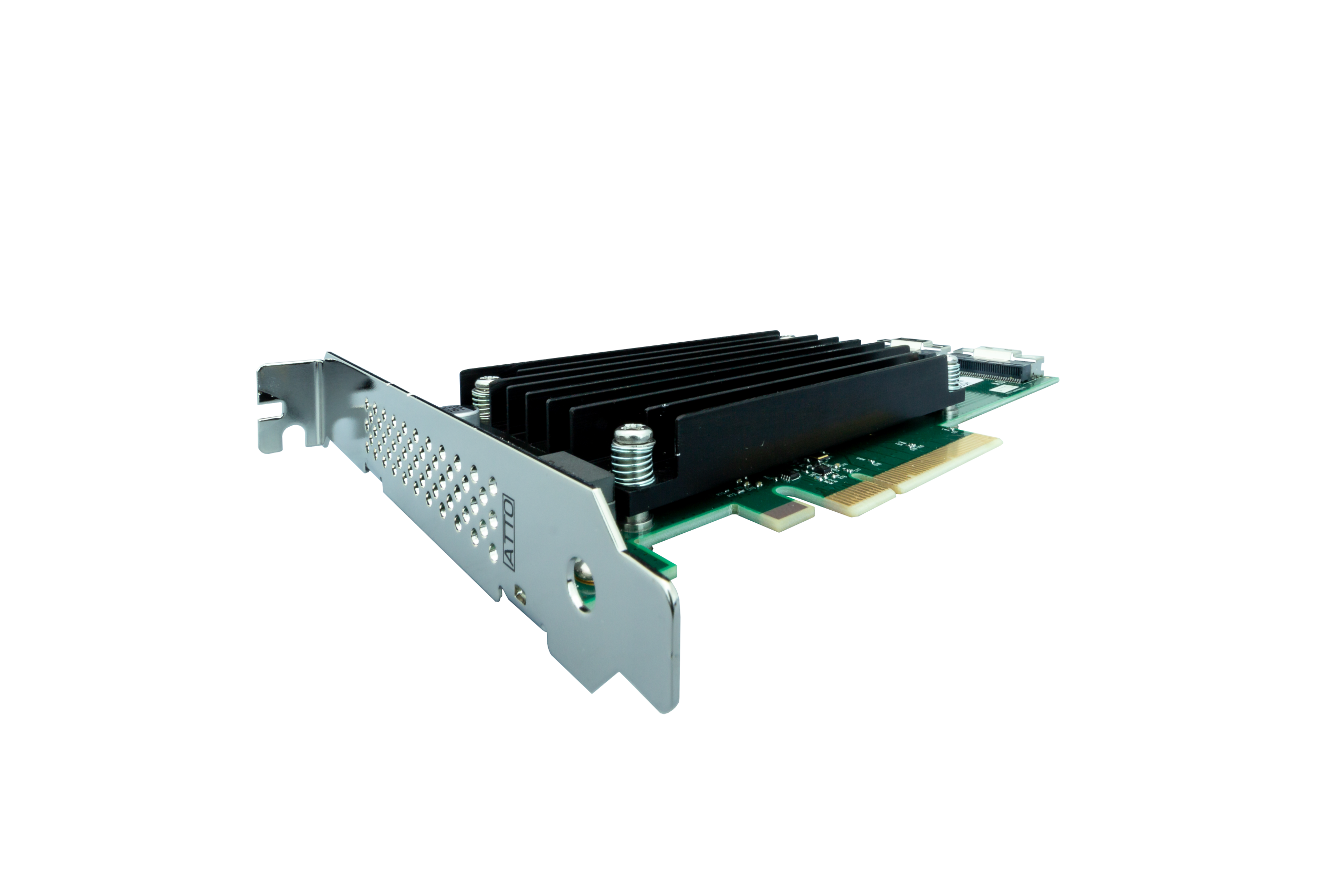
Backed by modern compute architecture, ATTO ExpressSAS is built for a world where infrastructure is constantly evolving and flexibility matters as much as performance – while meeting demands of today’s data protection and availability workflows without significant hardware complexity or cost.
See our Solutions and Resources pages for more information on enterprise IT and data center connectivity solutions.