
ATTO Technology, Graid Technology, and ScaleFlux
Redefine Agility at Scale in High-Performance Storage Solutions
As data-intensive workloads like AI, edge computing, and real-time analytics grow, IT leaders need to rethink how to deliver performance and flexibility across their infrastructure without increasing complexity or operational overhead. Success hinges on more than just speed; it requires fast, direct access to dense storage, along with intelligent control, visibility, and uncompromised data integrity.
The shift to NVMe has redefined expectations for parallelism, speed, and latency. However, traditional storage stacks often struggle to keep up due to CPU bottlenecks, inefficient data paths, and limited PCIe resources. This joint solution from ATTO, Graid Technology, and ScaleFlux is designed to overcome these challenges, unlocking the true performance and economic value of NVMe at scale
The Solution
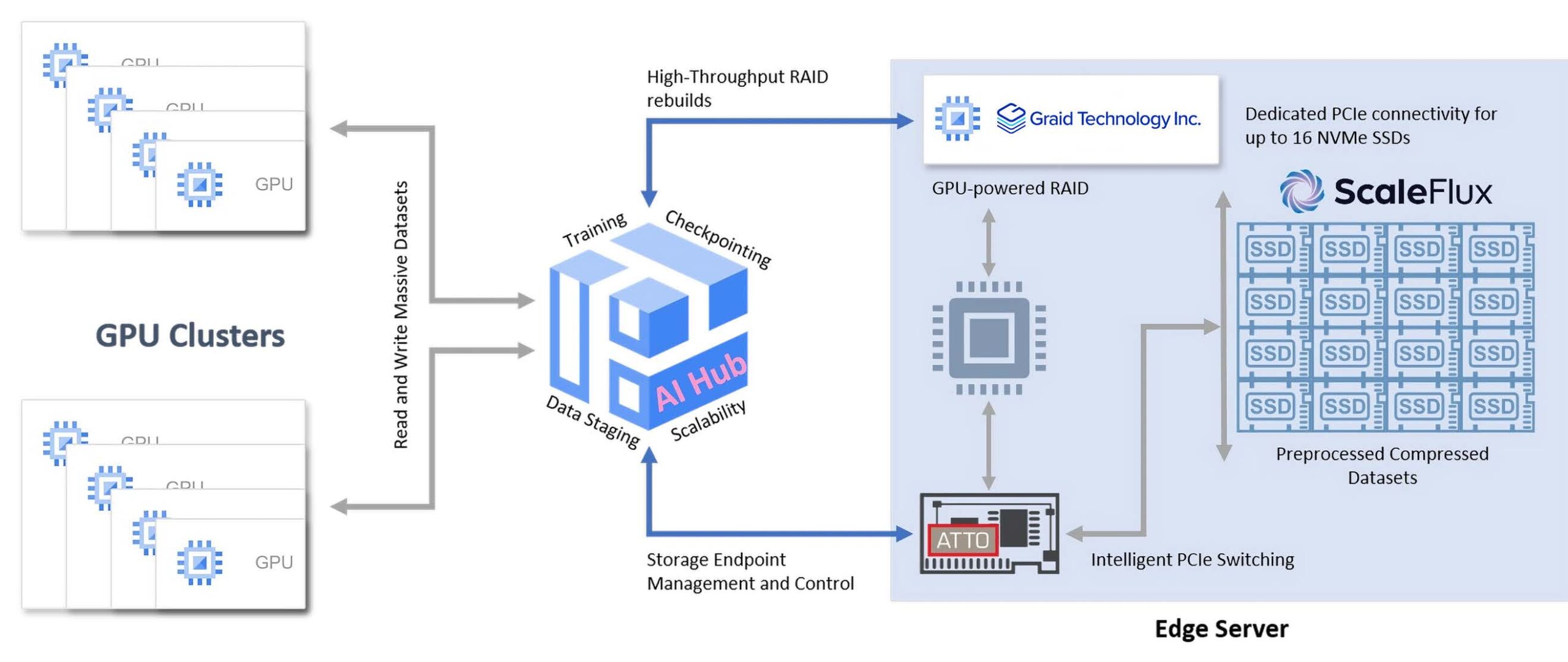
This joint architecture creates a low-latency pipeline to intelligent storage, accelerating data-intensive workflows from edge inferencing to large-scale training.
- ATTO ExpressNVM™ PCIe Switch Adapters create high-speed, direct NVMe connections between compute nodes and storage, bypassing CPU bottlenecks and eliminating unnecessary hops. With built-in FPGA intelligence, ExpressNVM provides granular control and visibility of storage assets that are not available with other commodity HBAs or RAID controller cards. This is ideal for workloads requiring rapid data ingestion and checkpoint writes.
- Graid Technology’s SupremeRAID™ uses a GPU to offload RAID operations, freeing up CPU resources and sustaining full NVMe and NVMe-oF performance with strong data protection. This approach replaces the need for CPU-bound RAID controllers and avoids consuming compute cycles from AI workloads. SupremeRAID™ calculations are significantly faster than traditional RAID implementations, offering high-performance data protection and faster rebuild times.
- ScaleFlux® Computational NVMe SSDs handle data compression and decompression directly on the drive, which reduces CPU overhead and accelerates I/O transactions. By offloading data compression from GPUs, these SSDs allow GPUs to focus on core tasks like modeling and training, reducing idle time and dramatically improving overall system performance.

Key Highlights
- Zero CPU Tax for RAID & Storage I/O: More CPU resources are available for other tasks such as data loading and orchestration.
- Optimized PCIe Lane Allocation: Intelligent PCIe switching ensures that NVMe drive groups can operate at full bandwidth simultaneously.
- Faster Dataset Preparation: Preprocessing and management tasks are offloaded, freeing up resources for AI computation and modeling.
- High-Density, Low-Latency Architecture: This architecture is essential for time-sensitive applications like real-time analytics and inferencing.
- Maximize Storage with Limited PCIe Slots: ATTO ExpressNVM™ can support up to 16 drives from a single PCIe x16 slot, while SupremeRAID™ AE provides data protection and maximizes the performance of high-performance ScaleFlux CDS5000 Series SSDs.
Use Cases
- High-Performance Computing & Research: Accelerate research cycles by enabling multiple GPU servers to share NVMe pools without CPU bottlenecks.
- Edge AI & Industrial IoT: Compact, high-throughput NVMe storage with GPU-offloaded RAID and on-drive preprocessing is ideal for space and power-constrained deployments, enabling real-time analytics at the edge.
- Media & Entertainment: Streamline the offloading and preparation of massive media assets for 4K/8K video ingest, VFX, and rendering pipelines while keeping the focus on creative workloads.
- Enterprise IT: Gain high throughput for ingesting massive datasets and performing frequent checkpointing, enabling rapid iteration for model optimization and computation.
This integrated solution from ATTO, SupremeRAID™, and ScaleFlux unlocks unprecedented performance, reliability, and efficiency for data-intensive workloads. It simplifies deployment, reduces bottlenecks, and maximizes the utilization of storage resources, allowing IT teams to focus on innovation